
Stacker crane (AS/RS): how it works, types (pallets, totes, cartons) and when to choose one
October 8, 2026 · 9 min read
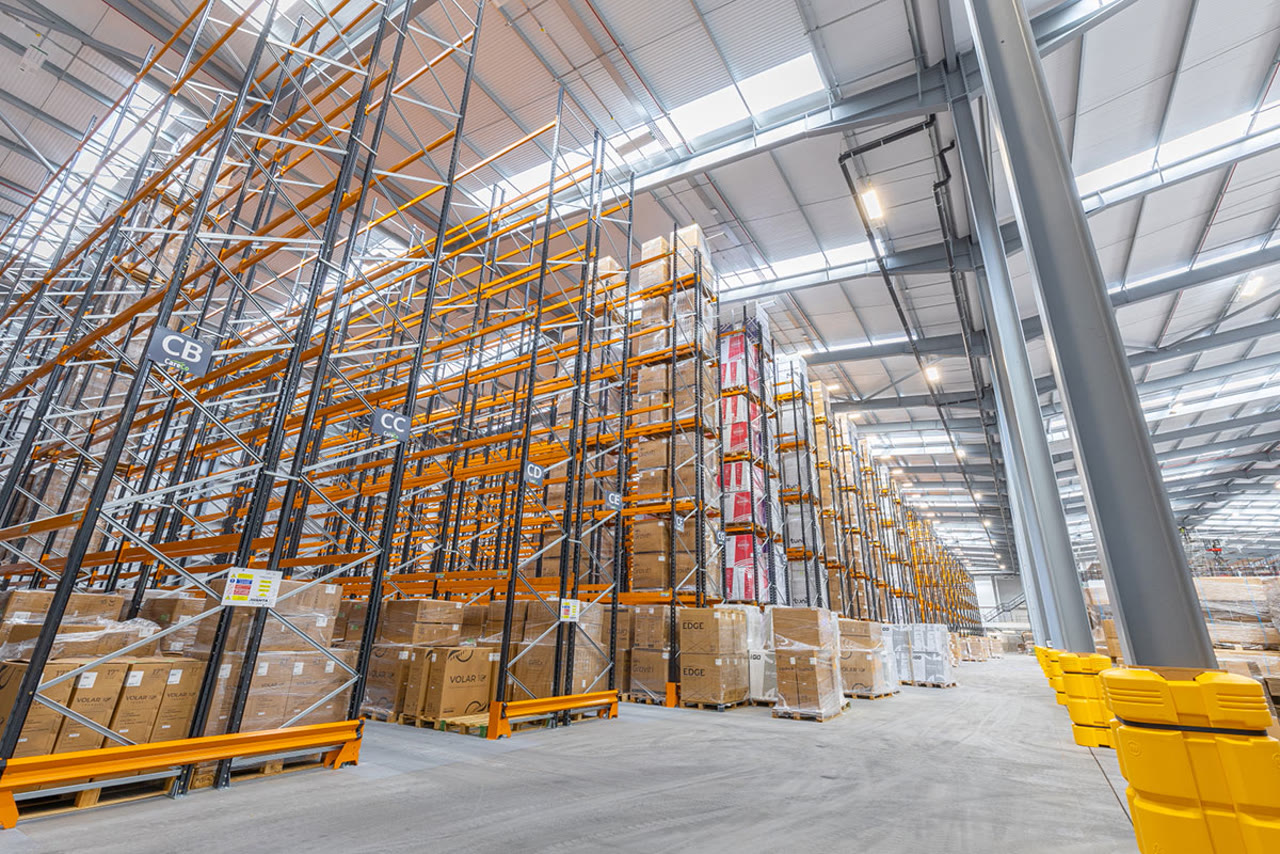
A stacker crane (the machine at the heart of an automated storage and retrieval system, or AS/RS) runs on a floor rail and a top guide rail in a narrow aisle, storing and retrieving pallets, totes or cartons in high-bay racking automatically. Manufacturers quote heights of up to 45 to 48 m for pallets. It is the answer for very dense stock and steady flows; the trade-off is a heavy investment that is locked into the building.
This guide explains how it works, which families exist, which standards apply in France and Europe, and when conventional racking with forklifts, or autonomous pallet trucks, are the better fit.
How a stacker crane works
The stacker crane runs on a rail anchored in the floor and is kept upright by a guide rail fixed to the top of the racking. It carries one or two vertical masts along which a carriage travels. On the carriage, a load-handling device, usually telescopic forks, sometimes a clamp or a shuttle, reaches into the storage location and picks up or sets down the load (Stow, High Bay documentation).
The machine combines three movements: travel along the aisle, lifting along the mast and fork extension to either side. It never leaves its aisle. At the end of the aisle, conveyors or transfer stations link it to picking and the docks. The stacker crane decides nothing: it executes the missions sent by the control system, the WCS, itself fed by the WMS.
That specialisation is what sets it apart from mobile robots: a stacker crane is a fixed machine on a rail, dedicated to one aisle, whereas an AGV or an AMR moves across several areas of the site.
Types: pallets, totes, cartons
There are two main families, depending on the load handled.
- The pallet stacker crane (“unit-load”) handles loads of around one tonne. It serves bulk storage, cold stores and high-bay warehouses.
- The tote and carton stacker crane (“mini-load”) handles light units, from a few dozen to a few hundred kilos, at high speed. It underpins many goods-to-person picking systems: the tote comes to the picker, not the other way round. Some load-handling devices grip the carton directly, with no tote.
In both families, locations can be single-deep (one load on each side of the aisle), double-deep, or multi-deep with a shuttle that fetches loads from the back. The greater the depth, the higher the density, but the slower access to any given load becomes.
A special case is the clad-rack silo: the roof and cladding are fixed directly to the racking structure, which also takes the loads from the stacker crane, wind and snow (Stow, Silo documentation). The racking becomes the building.
What manufacturers quote
The figures below are the maximums manufacturers quote for their ranges, not guaranteed values for a given project.
| Manufacturer | Family | Max. height | Load |
|---|---|---|---|
| Mecalux | Pallets | 45 m | 1,500 kg single-deep, 1,000 kg double-deep |
| Kardex | Pallets | 46 m | Not stated on the range page |
| Swisslog | Pallets | 48 m | Not stated, -30 to +50 °C |
| Kardex | Totes (mini-load) | 24 m | 50 to 300 kg |
| Swisslog | Totes (mini-load) | 24 m | Up to about 250 kg |
On speed, Mecalux quotes up to 160 m/min travel and 66 m/min unladen lifting for its pallet cranes; Jungheinrich quotes more than 6 m/s travel for a mini-load model. None of these manufacturers publishes a throughput in cycles per hour, however: it depends on aisle length, height and the locations served. The reference calculation method is FEM 9.851, which defines stacker crane cycle times. Ask the supplier for a throughput calculated with this method, on your layout, rather than a brochure figure.
The same goes for price: none of the manufacturers we consulted publishes a price list. A stacker crane is quoted after a study, and the project cost includes the racking, the conveyors, the software and often the building.
Automated turret crane or turret truck?
The two terms are often confused but do not describe the same machine. A turret truck (or very-narrow-aisle truck) is a manned truck working in very narrow aisles that picks pallets to the left, right and front; like any ride-on truck in France, it falls under CACES R489. The automated version applies the same principle without a driver: Mecalux describes its MT range, up to 14 m, as an automated trilateral stacker crane that replaces manned trilateral trucks in conventional racking (Interlake Mecalux). It is a bridge between the conventional warehouse and the automated store.
Standards, inspections and maintenance
The safety standard specific to stacker cranes is EN 528, “Rail dependent storage and retrieval equipment – Safety requirements for S/R machines”. The current edition is EN 528:2021, with amendment A1 of 2022. It covers rail-bound machines from manual to fully automatic control, including satellite shuttles and aisle transfer cars (CEN, EN 528:2021). From 20 January 2027, new machines fall under the EU Machinery Regulation 2023/1230, which replaces Directive 2006/42/EC (EUR-Lex).
For periodic inspections in France, circular DRT 2005-04, which comments on the order of 1 March 2004 on lifting equipment, explicitly lists “stacker cranes with an on-board operator” among the equipment subject to periodic inspection (VGP) (circular DRT 2005-04). For a fully automatic stacker crane working in an area that is inaccessible during production, the text does not say so explicitly: have your inspection body confirm the applicable regime and keep its answer on file. FEM has also published a model inspection logbook for stacker cranes (FEM 9.871), useful to structure follow-up.
Maintaining a stacker crane raises a specific safety issue: the work takes place in the aisle, at height, on a machine that can start moving. Lockout, secured access to the aisle and means of rescue at height are the three points to require from the manufacturer and write into your procedures.
Installation: what the project involves
Installing a stacker crane is not buying a machine, it is building a system. The project affects the building (clear height, floor slab, possibly a silo), the racking, erected to tight tolerances (Stow, for example, limits upright out-of-plumb to ±15 mm), the end-of-aisle conveyors and the software. It also assumes a flow stable enough for the throughput calculated at the outset to remain right for years.
Two practical consequences. First, the project is decided early, often together with the building itself. Second, each aisle depends on a single machine: a breakdown immobilises the loads it serves, hence the importance of the maintenance contract and response times.
Stacker crane, forklifts or mobile robots?
The stacker crane is not the only way to automate a warehouse. The table compares three approaches on the criteria that decide in practice.
| Criterion | Stacker crane | Racking + forklifts | Autonomous pallet trucks |
|---|---|---|---|
| What it automates | High-bay storage | Nothing | Pallet transfers at floor level |
| Building | Designed around it; sometimes the racking is the building | Existing | Existing, no building work |
| Density | Very high | Limited by lift height and aisle width | That of the existing storage |
| Reversibility | Low: fixed installation | High | High: robots can be redeployed |
| Weak point | One machine per aisle | Dependence on forklift drivers | Does not store at height |
A stacker crane makes sense when stock is large, the product range narrow, the flow steady and the building still to be built or adapted. For an existing site whose difficulty is moving pallets back and forth between docks, storage and production lines, automation happens at floor level instead, with robots that travel the current aisles without touching the building; see our guide to automating a warehouse with no building work. The two approaches often combine: the stacker crane delivers the pallet to the end of the aisle, and a mobile robot takes it to the dock or the line.
FAQ
What is the difference between a stacker crane and a forklift?
A forklift is driven by an operator and moves around the whole warehouse. A stacker crane is an automatic machine fixed to a rail, dedicated to one narrow aisle, that stores and retrieves loads with no driver. It reaches much higher, up to 45 to 48 m depending on the manufacturer, but never leaves its aisle.
How high can a stacker crane go?
For pallets, manufacturers quote up to 45 m (Mecalux), 46 m (Kardex) or 48 m (Swisslog). For totes, mini-load models reach around 24 to 25 m. These are range maximums: the real height depends on the building, the floor slab and the racking.
Which standard applies to a stacker crane?
The dedicated safety standard is EN 528:2021 with its 2022 amendment A1, “Safety requirements for S/R machines”. The reference method for calculating cycle times is FEM 9.851. From 20 January 2027, new machines fall under the EU Machinery Regulation 2023/1230.
Is a stacker crane subject to periodic inspection in France?
Circular DRT 2005-04 explicitly lists stacker cranes with an on-board operator among the lifting equipment subject to the inspections of the order of 1 March 2004. For a fully automatic stacker crane, the text does not say so explicitly: have your inspection body confirm the regime.
How much does a stacker crane cost?
No manufacturer publishes prices: a stacker crane is quoted after a study, because the cost depends on height, the number of aisles, conveyors, software and often the building. Compare offers at equal throughput, calculated with FEM 9.851, and with an equivalent maintenance contract.
Related reading
- Types of warehouse racking, to place the stacker crane among other storage solutions.
- Goods-to-person: the picking principle that often relies on a mini-load crane.
- Logistics robots: the 7 types of warehouse robots, from stacker crane to AMR.
- AGV vs AMR: the two families of mobile robots that complement an automated store.
- Warehouse and logistics: automating pallet transfers at floor level.
Is your issue pallets moving between docks, storage and lines rather than high-bay storage? An autonomous pallet truck works in your current aisles, with no rail and no building work. Discover the robot or have your aisles checked: your regional contact sends back a written verdict on your site.
Let's assess your aisles before everyone else does
Distribution opens soon in France. In the meantime, four questions are enough: your regional contact sends back a written verdict on your site, with no price and no date.