
Warehouse robots: the 7 types of logistics robots explained
August 18, 2026 · 9 min read
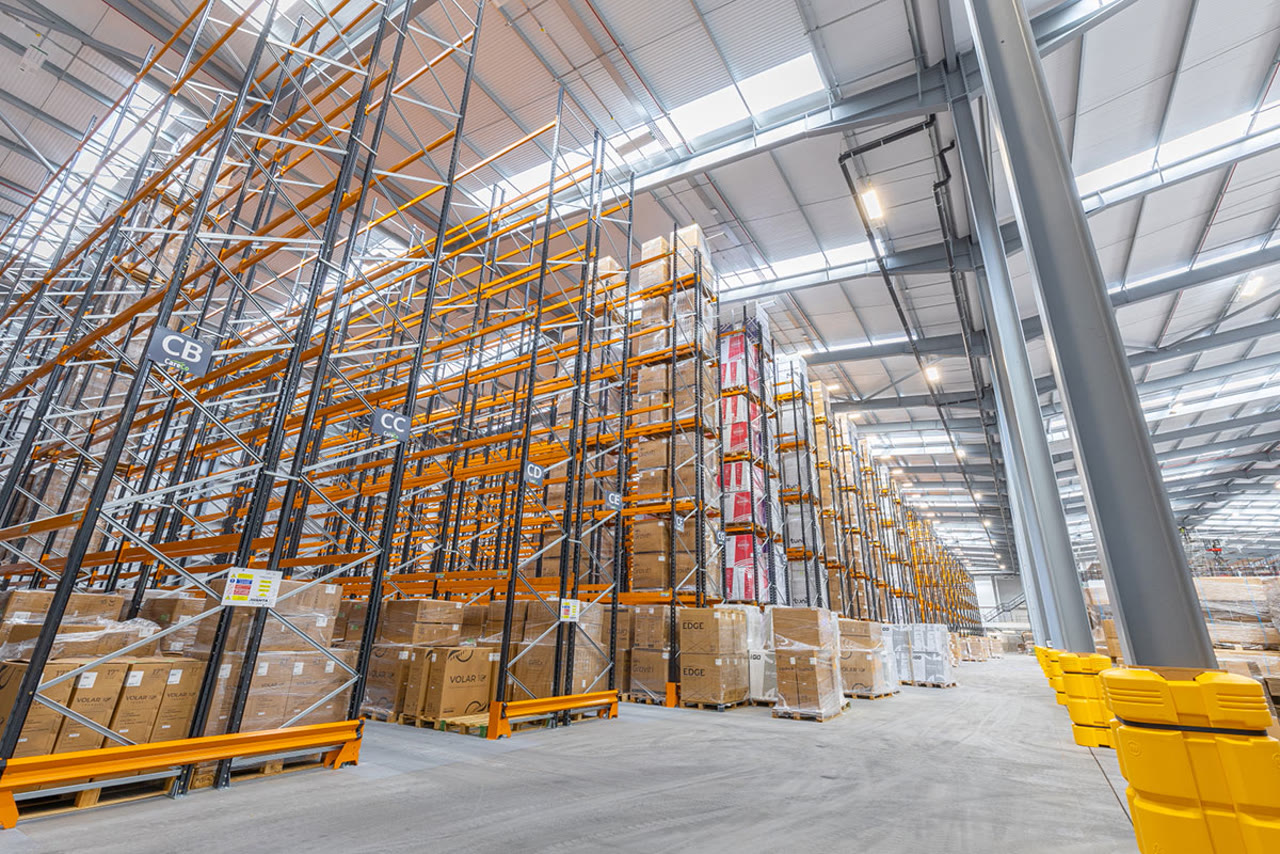
A warehouse robot is an autonomous or semi-autonomous machine that automates a warehouse flow: pallet transport, storage, order picking or load handling. Seven broad families stand out by function: AGV, AMR, autonomous pallet truck, autonomous stacker, goods-to-person robot, picking robot and conveying cobot, plus an eighth, still-emerging category: the humanoid robot. This guide details each type, its use cases and the market players to know.
The warehouse robot market in a few numbers
The global mobile robot market is expected to grow from $5 billion in 2024 to $14 billion in 2030, a 19% annual growth rate, nearly eight times faster than fixed automation (source: Interact Analysis). Within this market, the AGV share is falling from 33% to 20% in favor of AMRs, evidence of a structural shift toward infrastructure-free navigation.
The most useful figure for a decision-maker: autonomous trucks and pallet trucks account for only 14% of mobile robot units sold, but 33% of the sector's revenue in 2030 (source: Interact Analysis). It's the most "premium" segment of all logistics robotics, consistent with the positioning of the robot.
1. The AGV: the fixed-path logistics robot
Short definition: the AGV (Automated Guided Vehicle) follows a predefined path, set out by infrastructure — wire guidance, magnetic strips, QR codes or laser reflectors for triangulation.
Use case: high-volume, repetitive shuttle runs between two fixed points (from the end of a production line to storage, feeding a machine), on sites designed for automation.
Example player: Rocla (Mitsubishi Logisnext group, Finland), a European pioneer of pallet and stacking AGVs, distributed in France through the Logisnext network.
2. The AMR: the freely navigating logistics robot
Short definition: the AMR (Autonomous Mobile Robot) locates itself through SLAM mapping using onboard LiDAR and cameras, with no guidance infrastructure at all. It detects and goes around obstacles on its own.
Use case: existing buildings, flows that change regularly, coexistence with pedestrians and driven vehicles — this is the family best suited to an SME with no infrastructure construction work.
Example player: the MiR1200 Pallet Jack (Mobile Industrial Robots, Denmark, Teradyne group), fitted with 3 360° laser scanners, 5 3D cameras and AI-based pallet detection, considered the most direct comparable to the robot on the European market.
3. The autonomous pallet truck: the most cost-effective logistics robot
Short definition: a sub-category of AGV or AMR specialized in lifting and transporting pallets over short distances, with or without an onboard operator.
Use case: dock-to-storage rotation, line-side restocking, shuttle runs between picking zones — the most repetitive flow in the warehouse and one of the leading contributors to musculoskeletal disorders in the forklift operator's job.
Example player: the autonomous pallet truck, distributed in France by Easy to Carry (2,000 kg capacity, 3D LiDAR navigation and depth cameras, forks inserted in about 20 seconds, no infrastructure required). On the entry-level side, the EP Equipment EXP15 (1,500 kg) lists at around €12,000 excl. VAT, a rarity in a market where pricing is most often quote-based.
4. The autonomous stacker: automating high-level storage
Short definition: a variant of the autonomous pallet truck able to lift a pallet to store it at height, across multiple rack levels.
Use case: putaway and retrieval in conventional pallet racking, when volume doesn't yet justify a full automated storage system.
Example player: Balyo (France), with its LOWY range, a 1,600 kg stacker with lift height up to 3 meters, proprietary geo-guidance combined with 3D LiDAR and a digital twin of the site.
5. The goods-to-person robot: stock that comes to the picker
Short definition: instead of sending an operator to fetch an item, this robot brings the container (tote, carton) to the picking station. This is the "goods-to-person" principle, to be distinguished from pallet transport.
Use case: e-commerce and distribution with a large number of SKUs and split orders, where storage density and picking speed take priority over heavy-load transport.
Example player: Exotec (France), with its Skypod system, a goods-to-person AS/RS for totes, not pallets. Exotec produced its 4,000th robot and opened a new headquarters near Lille in early 2026 (source: Exotec); it's the French reference in this category, even though it isn't a direct competitor to the autonomous pallet truck on pallets.
6. The picking robot: automating order preparation
Short definition: a robot able to pick up a single item from a container (gripper or suction-cup grasping, often driven by vision and artificial intelligence) to build an order.
Use case: very high-throughput unit picking, typically downstream of a goods-to-person system, on items of varying shape and weight.
Example player: Sparrow, the unit-picking robot deployed by Amazon in its distribution centers, alongside Cardinal and Robin for sorting (source: GeekWire). On the vendor side, Geek+ (China), the global AMR market leader, focuses on this goods-to-person and picking approach rather than on pallets.
7. The conveying cobot: the assistant that follows the operator
Short definition: a cobot (collaborative robot) works in direct contact with a human operator, often following or assisting them, without fully replacing their actions — to be distinguished from an industrial robot that operates alone inside a closed cell.
Use case: "human follows robot" or "robot follows human" order picking, conveying a picking cart through the aisles while the operator picks items by hand.
Example player: the Co-bot Pallet Jack from Vecna Robotics (United States), designed to accompany an operator on their palletizing rounds rather than to operate in full autonomy.
And tomorrow: the humanoid robot, an emerging 8th category
Short definition: a bipedal, human-shaped robot, theoretically able to manipulate objects and move through spaces designed for humans, with no special adaptation.
Where things actually stand: the most documented case is Agility Robotics, whose Digit robot has passed 100,000 totes moved in production at logistics provider GXO (source: Agility Robotics / Robotics and Automation News), under the first multi-year RaaS-type agreement for a warehouse humanoid. In China, Unitree shipped around 5,500 humanoids in 2025, nearly a third of the global market, and is preparing an IPO in Shanghai (source: CNBC, restofworld.org). The manufacturer, already present in the autonomous pallet truck space, is separately developing its own semi-humanoid D7 and bipedal D9 models.
Bottom line: production deployment remains marginal and concentrated on a handful of pilot sites. For the vast majority of French warehouses, the 7 types of logistics robots presented above cover most real-world needs today; the humanoid robot is still more of a technology demo than a standard automation choice.
Summary table of the 7 types of warehouse robots
| Type of logistics robot | Function | Infrastructure required | Example player |
|---|---|---|---|
| AGV | Fixed-path transport | Yes (wires, reflectors, QR codes) | Rocla (Mitsubishi Logisnext) |
| AMR | Free-navigation transport | No (SLAM mapping) | MiR1200 Pallet Jack |
| Autonomous pallet truck | Pallet lifting and transport | Usually not | the robot, EP Equipment EXP15 |
| Autonomous stacker | High-level storage (racking) | Usually not | Balyo LOWY |
| Goods-to-person robot | Brings the tote to the picker | Dedicated structure (grid, shuttles) | Exotec Skypod |
| Picking robot | Single-item grasping | Varies by integration | Amazon Sparrow, Geek+ |
| Conveying cobot | Assists the operator directly | No | Vecna Co-bot Pallet Jack |
| Humanoid robot (emerging) | Versatility, varied tasks | No, in theory | Agility Digit at GXO |
How to choose your logistics robot based on your needs
The right type of robot depends first on the nature of the flow you want to automate, not on a passing trend.
- You transport pallets between the dock and storage: an autonomous pallet truck (AMR) is the simplest entry point, with no infrastructure work.
- You also need to store at height in existing racking: look at an autonomous stacker, complementary to the pallet truck.
- Your flow is a very high-throughput fixed circuit (e.g. continuous line feeding): the classic AGV remains relevant and sometimes more cost-effective.
- You prepare e-commerce orders with many SKUs: goods-to-person (Skypod-type) or picking robots address a different need than pallet transport — often complementary, not interchangeable.
- You want to keep an operator in the loop (quality control, fine manual work): the conveying cobot assists without replacing.
- You run a mixed fleet of robots and forklift operators: check interoperability (the VDA 5050 standard) and plan for the applicable safety framework — for driverless robots, the reference is the EN ISO 3691-4 standard, supplemented by employer-provided training and authorization; have your setup validated with your Carsat or INRS rather than relying on a single sales opinion.
For most French SMEs and mid-sized companies, the most cost-effective starting point remains pallet transport: it's the most repetitive flow, the most labor-intensive, and the one where return on investment is measured fastest.
FAQ
What is the difference between an AGV and an AMR?
An AGV follows a fixed path defined by guidance infrastructure (wires, reflectors, QR codes) and stops when it meets an obstacle. An AMR navigates freely using SLAM mapping, with no infrastructure, and goes around obstacles on its own. That said, the line is blurring: some modern AGVs now incorporate AMR-like technologies.
What is a cobot in logistics?
A cobot (collaborative robot) works in direct contact with a human operator, assisting or following them in their tasks, unlike an industrial robot that operates alone inside a closed cell. In a warehouse, a conveying cobot typically accompanies an order picker along their picking rounds.
What is goods-to-person in a warehouse?
Goods-to-person describes a system where a robot or shuttle brings the container to the operator's workstation, instead of the operator walking through the aisles. This is the principle behind systems like Skypod, suited to order picking with a high density of SKUs.
Are humanoid robots already used in warehouses?
Yes, but still on a limited scale: the most advanced case is Agility Robotics' Digit robot, which has passed 100,000 totes moved in production at logistics provider GXO. For most warehouses, specialized robots (autonomous pallet truck, stacker, AMR) remain the most mature and cost-effective choice in 2026.
Which logistics robot should you choose to start automating your warehouse?
Start with the most repetitive and physically demanding flow: transporting pallets between the dock and storage. An AMR-type autonomous pallet truck deploys with no construction work, in a matter of weeks, and lets you measure a return on investment before considering other types of robots.
Related reading
- AGV vs AMR: what are the differences, and which should you choose for your pallets? — for a deeper look at the technical distinction between the two navigation families.
- Autonomous pallet truck: the complete 2026 guide — a full focus on the most cost-effective type of robot for an SME.
- autonomous pallet truck: a complete overview of the autonomous pallet truck, the concrete example of a logistics robot distributed by Easy to Carry.
- MiR1200 Pallet Jack vs autonomous pallet truck — a detailed comparison between two pallet AMRs on the market.
- ROI of a pallet-truck robot — how to calculate the return on investment before choosing a type of robot.
Not sure which type of logistics robot suits your warehouse? Easy to Carry distributes the robot in France, a 2,000 kg autonomous pallet truck deployable with no infrastructure work. Discover the autonomous pallet truck or request the free site pre-assessment: we study feasibility for your pallet flows, with a written verdict within 48 business hours.
Let's assess your aisles before everyone else does
Distribution opens soon in France. In the meantime, four questions are enough: your regional contact sends back a written verdict on your site, with no price and no date.