
Warehouse picking: the 8 order-picking methods compared
August 18, 2026 · 9 min read
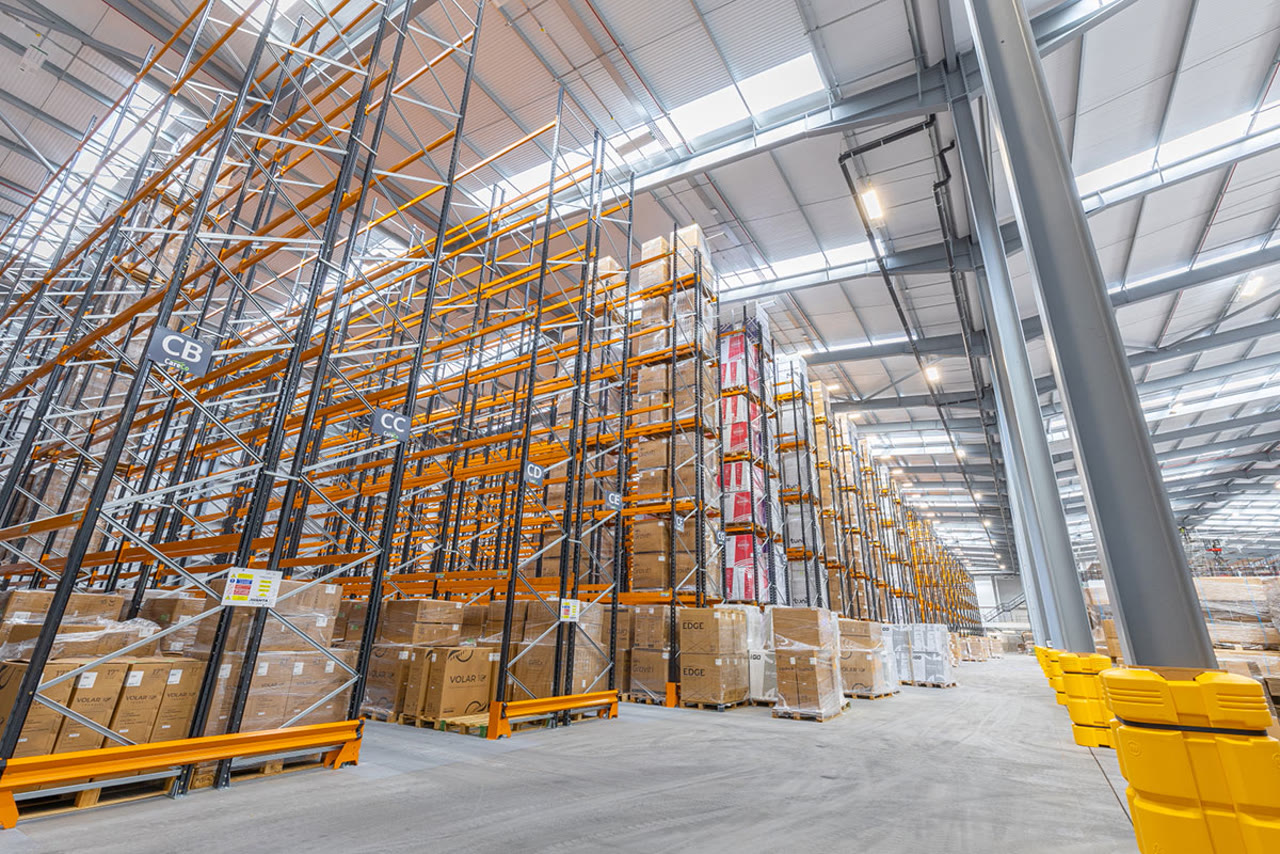
Warehouse picking — the operation of retrieving the items in an order from stock — accounts on its own for 50 to 55% of a warehouse's operating costs (source: Grett; Hardis Supply Chain). There are eight main methods: order picking, batch picking, zone picking, wave picking, voice picking, pick-to-light, RF scanning and robotic goods-to-person. This guide compares their principles, use cases, advantages and limitations to help you choose.
What is warehouse picking, and why is it the top cost item
Picking (or order picking) means retrieving the ordered SKUs from their storage locations before they are packed and shipped. Two approaches compete: man-to-goods, where the operator moves to the merchandise, and goods-to-person, where the merchandise is brought to a fixed station, usually by robots (source: Mecalux; Hardis Supply Chain).
It is the warehouse's top cost item, far ahead of receiving or storage: in a typical man-to-goods picking operation, most of a picker's time is spent not retrieving items but walking between locations, which explains the 50–55% share detailed below.
Two indicators frame the expected performance: the average cost of a picking error, estimated at around €20 per order (source: Blogistics), and the accuracy target, generally set above 99.5% (source: Flexfulfillment).
The 8 warehouse picking methods: definitions and use cases
1. Order picking (single order picking)
A picker handles one order from start to finish before moving to the next. It is the simplest man-to-goods method to set up.
- Use case: small warehouses, complex or customized orders (pharma, spare parts).
- Advantages: zero risk of mixing orders, immediate traceability, no software investment.
- Limitations: maximum walking time per order, the lowest productivity as soon as volume increases.
2. Batch picking
The picker groups several orders containing similar SKUs and picks them in a single pass through the aisles, then sorts them at the end of the round (sorting into totes or bins).
- Use case: high-volume e-commerce, orders sharing common SKUs.
- Advantages: sharply cuts travel compared with order picking, productivity gains on fast-moving catalogs.
- Limitations: requires an extra sorting/allocation step, risk of misallocation if controls are weak.
3. Zone picking
The warehouse is divided into fixed zones, with each picker assigned to their own; the order moves (conveyor, cart, relay) from one zone to the next until it is complete.
- Use case: large multi-SKU warehouses, zones with different temperature or safety requirements.
- Advantages: picker specialization, reduced individual travel, task parallelization.
- Limitations: inter-zone coordination via the WMS, risk of a bottleneck if one zone is unbalanced.
4. Wave picking
Orders are grouped and released in scheduled “waves” — by carrier departure slot, customer type or zone — often combined with batch or zone picking.
- Use case: multiple truck departures per day, activity peaks (sales, click-and-collect).
- Advantages: smooths the workload, aligns picking with transport and dock constraints.
- Limitations: depends on a WMS capable of planning waves; poorly calibrated, the effect can backfire.
5. Voice picking
The picker receives instructions through a headset connected to the WMS and confirms each pick by voice, hands and eyes free (source: Hardis Supply Chain).
- Use case: warehouses with a high volume of order lines, environments where hands must stay free (food processing, cold storage).
- Advantages: productivity gains and fewer errors than paper picking or a handheld terminal, improved ergonomics.
- Limitations: equipment cost (headsets, software license), training required, sensitive to ambient noise.
6. Pick-to-light
Light indicators installed on racks or bins light up to show the location and quantity to pick; the operator confirms with a button (source: Shippingbo).
- Use case: fast-moving zones, kitting, multi-order picking.
- Advantages: high throughput, minimal training (ideal for temp staff), very low error rate.
- Limitations: hardware investment per location, not very flexible if the layout changes often.
7. RF scanning (radio-frequency scan picking)
The picker scans a barcode or QR code at each step (location, item, order) using a handheld terminal, with real-time confirmation in the WMS.
- Use case: a cross-cutting method, combinable with order, batch or zone picking.
- Advantages: fine-grained traceability, built-in quality control, moderate cost compared with voice or light systems.
- Limitations: ties up one hand for the terminal, lower throughput than voice picking or pick-to-light.
8. Goods-to-person (robotic)
The merchandise comes to the picker, who stays at a fixed station, via robots that move shelving units or totes — an approach popularized in France by integrators such as Exotec with its Skypod robots (source: Exotec).
- Use case: very high-volume e-commerce and 3PL, dense catalogs; Cdiscount deployed Exotec Skypod robots in Bordeaux and then Réau, and Renault Villeroy installed 191 AI-driven Skypod robots, cutting processing time sixfold and enabling +25% more orders processed (source: CIO Online).
- Advantages: near-elimination of foot travel, the highest productivity and storage-density gains of the eight methods.
- Limitations: the heaviest investment, WMS/WCS integration is a must, ROI mainly justified at high volume.
Comparison table of the 8 picking methods
| Method | Logic | Best use case | Throughput | Investment |
|---|---|---|---|---|
| Order picking | Man-to-goods | Small warehouse, complex orders | Low | None |
| Batch picking | Man-to-goods | High-volume e-commerce | Medium to high | Low (WMS) |
| Zone picking | Man-to-goods | Large multi-SKU warehouse | Medium | Low to medium |
| Wave picking | Man-to-goods (scheduling) | Multiple departures, activity peaks | Medium | Medium (advanced WMS) |
| Voice picking | Man-to-goods (guidance) | High line volume, hands-free | High | Medium |
| Pick-to-light | Man-to-goods (guidance) | Fast-moving items, kitting | Very high | Medium to high |
| RF scanning | Man-to-goods (control) | Cross-cutting, traceability | Medium | Low to medium |
| Robotic goods-to-person | Robotic | Very high volume, e-commerce/3PL | Very high | High |
The weight of picking in operating costs
Picking absorbs 50 to 55% of a warehouse's operating costs (source: Grett; Hardis Supply Chain), making it the biggest productivity lever available to a logistics manager, well ahead of receiving or storage. Each error costs an average of €20 (source: Blogistics), including returns, re-shipping and goodwill gestures; at the scale of several thousand lines processed per day, falling even a few points short of the 99.5% accuracy target (source: Flexfulfillment) quickly weighs on the margin.
Documented cases in France show the scale of gains possible with the most advanced methods: Renault Villeroy cut its processing time sixfold and increased orders processed by 25% after deploying 191 AI-driven Skypod robots (source: CIO Online); E.Leclerc Seclin reduced its picking time by 70% on its click-and-collect operation (source: Exotec). These results relate to robotic goods-to-person, the most capital-intensive method in this comparison, relevant beyond a certain volume rather than a starting point for every warehouse.
How an AMR/autonomous pallet truck supports picking (without replacing order pickers)
Robotic goods-to-person (Skypod and equivalents) automates detail picking — unit-level retrieval from totes. An autonomous pallet truck like the robot, a 2-tonne pallet-handling robot, plays a different, complementary role: it does not pick items, it automates the full-pallet flows that feed the picking zones.
In practice, an AMR of this type can take on three tasks adjacent to picking, whichever method is used (order, batch, zone or wave).
- Replenishing picking zones: bringing a full pallet from reserve stock to the picking location, without tying up a forklift operator or interrupting pickers.
- Removing completed or empty pallets: transferring finished orders to the shipping dock, or returning empty supports to the storage area.
- Dock ↔ stock shuttle runs for cross-docking, around the perimeter of the zones where pickers work.
The point is to cut the time forklift operators and pickers spend on heavy handling trips rather than value-added tasks, without replacing them. The robot deploys with no infrastructure work (no rails, no conveyor), making it an incremental addition to existing picking methods rather than a full warehouse overhaul.
On the regulatory side, operating a ride-on truck falls under CACES R489, while autonomous mobile robots are governed by the EN ISO 3691-4 standard and an authorization/training scheme defined by the employer, to be validated with your Carsat or INRS before deployment. On budget, autonomous pallet trucks generally range from €30,000 to €150,000 depending on the model; for precise pricing, it's best to request a quote.
How to choose your warehouse picking method
The choice mainly depends on three variables: daily order volume, SKU variety, and the budget available for equipment or the WMS.
- Low volume, high variety: order picking, possibly RF scanning.
- High volume, homogeneous catalog: batch picking, complemented with pick-to-light for fast-moving SKUs.
- Large, multi-zone warehouse: zone picking, orchestrated in waves.
- Very high volume, budget available: robotic goods-to-person, prioritized for fast-moving SKUs.
In practice, most warehouses combine several methods: batch picking for the bulk of orders, zone picking for bulky items, voice or RF for quality control. Automating pallet flows then provides support, whatever combination is chosen.
FAQ — Warehouse picking
What is the difference between picking and packing?
Picking means retrieving the items in an order from stock; packing then means packaging them for shipment. These are two distinct steps in order fulfillment, sometimes performed by the same operator, sometimes by separate teams depending on the warehouse's organization.
What is goods-to-person?
Goods-to-person is a method where the merchandise is brought to a fixed picking station, usually by robots that move shelving units or totes, as opposed to man-to-goods, where the operator moves to the stock. It offers the highest throughput but requires the heaviest investment of the eight methods.
How can picking errors be reduced?
By combining guidance (voice picking, pick-to-light) with control (RF scanning, double-checking), and by limiting the error-prone trips through batch or zone picking. The average cost of an error is around €20 per order (source: Blogistics): every point of accuracy gained has a direct impact on the margin.
Which picking method should you choose for a small warehouse?
Order picking is often the simplest to implement for low volume or complex orders, with no heavy software investment. As soon as volume increases, batch picking with an entry-level WMS delivers significant productivity gains at a controlled cost.
Does an AMR robot replace order pickers?
No. An autonomous pallet truck like the robot automates the pallet flows (replenishment, removal) that surround picking, but does not pick items in place of order pickers. It supports the teams, particularly on repetitive trips, without replacing them.
Related reading
- Logistics robots: the 7 types of warehouse robots
- Automating a warehouse with no conveyors or construction work: a how-to
- ROI of a pallet-truck robot: the complete calculation method
- Forklift-operator shortage: 5 concrete solutions
- Autonomous pallet truck: the complete 2026 guide
Strengthen your picking with Easy to Carry
Picking already absorbs more than half of your operating costs: don't let full-pallet trips add further to your teams' workload. The autonomous pallet truck — a 2-tonne autonomous pallet truck deployable with no construction work — automates replenishment and removal in support of your pickers. Request the free site pre-assessment: we study your picking organization based on your answers, with a written verdict within 48 business hours.
Let's assess your aisles before everyone else does
Distribution opens soon in France. In the meantime, four questions are enough: your regional contact sends back a written verdict on your site, with no price and no date.