
Autonomous pallet truck: the complete guide to automating your pallet flows in 2026
August 18, 2026 · 8 min read
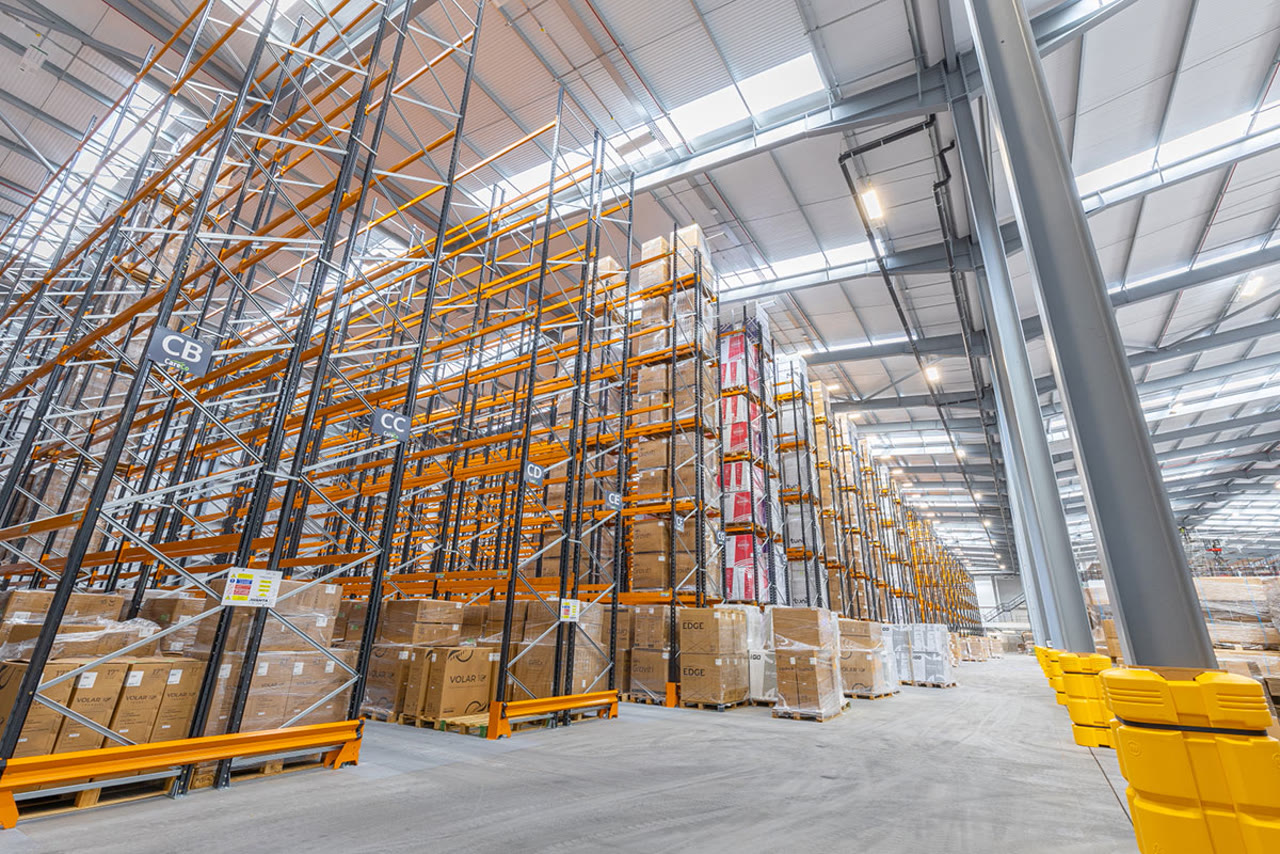
An autonomous pallet truck is a mobile robot that transports pallets without an operator: guided by LiDAR and cameras, it locates the pallet, engages it, moves it and sets it down on its own, with no rail or floor marking. Expect €30,000 to €150,000 excluding integration depending on the model. How it works, differences from an AGV, use cases, a 2026 comparison, price and regulations: here is the complete guide.
Autonomous pallet truck: definition and vocabulary
An autonomous pallet truck, also called a pallet-truck robot, a robotic pallet truck or a pallet AMR (Autonomous Mobile Robot), is a driverless handling vehicle dedicated to the horizontal transport of pallets. Like a conventional pallet truck, it lifts the load a few centimetres (a lift height of around 200 mm at most): it moves pallets but does not stack them at height, which is the role of the stacker.
The whole difference lies in the autonomy. Where an electric pallet truck needs an operator, the robot carries out its missions on its own: it receives a transport order (via a call button or the WMS, the warehouse management software), goes to fetch the pallet, delivers it, then moves on to the next one, including at night or on weekends.
The context explains the acceleration: more than 4 million mobile robots are expected to be installed worldwide by the end of 2027 (source: Interact Analysis). In France, two realities are pushing SMEs and large groups to equip themselves: around 15,000 vacant forklift operator positions in 2026 (source: Focusur, 2026) and musculoskeletal disorders (MSDs) that account for more than 80% of recognised occupational diseases (source: INRS).
How does an autonomous pallet truck work?
3D LiDAR and VSLAM: the robot's eyes
At the heart of the system is SLAM navigation (Simultaneous Localization and Mapping): the robot maps your site and then locates itself continuously, with no external beacon. 3D LiDAR scans the environment with lasers and measures distances in three dimensions; VSLAM (visual SLAM) does the same using cameras. Recent models combine both: the robot merges 3D LiDAR-SLAM, VSLAM and depth cameras for 360° perception.
Artificial intelligence completes this perception: pallet recognition (including non-standard pallets), detection of whether a slot is occupied. The MiR1200 Pallet Jack carries AI trained on 1.2 million images; the autonomous pallet truck self-corrects a pallet offset of up to 15 cm and 15° at the moment of pick-up.
Navigation with no infrastructure
Unlike legacy AGVs (Automated Guided Vehicles), a latest-generation autonomous pallet truck needs no buried wire, no rail, no wall-mounted reflectors and no floor QR codes. Deployment comes down to mapping the site and configuring the missions, with no construction work and no production stoppage. Reorganising your warehouse? You update the software map, not the building.
Built-in safety and fleet operation
These robots detect people, vehicles and obstacles in real time: they slow down, stop or recalculate their route. A supervision platform (this manufacturer's supervision platform, T-ONE at Toyota) dispatches the fleet's missions, interfaces with the WMS via API and can control elevators and automatic doors. The VDA 5050 interoperability standard makes it easier for robots from different brands to work side by side, though this should be checked model by model.
Autonomous pallet truck, wire-guided AGV, electric pallet truck: what are the differences?
Three families of equipment compete for pallet transport; the table below sums up what sets them apart.
| Criterion | Conventional electric pallet truck | Wire-guided AGV or reflector laser | Autonomous pallet truck (AMR) |
|---|---|---|---|
| Operation | Walk-behind operator (tiller) | Driverless, fixed path | Driverless, computed path |
| Guidance | — | Buried wire, rails or wall reflectors | 3D LiDAR + cameras (SLAM), no infrastructure |
| Installation work | None | Substantial (floor cuts, fitting reflectors) | None: software mapping |
| Changing flows | Immediate (human) | New construction work | Simple software update |
| Obstacle on the path | Steered around by the operator | Stops and waits | Dynamic avoidance, route recalculation |
| Labour | 1 operator per machine | Supervision | Supervision |
| Indicative price excl. VAT | €990 to €8,615 | €30,000 to €150,000 | €30,000 to €150,000 (entry-level from ~€12,000) |
The electric pallet truck remains unbeatable to buy, but its real cost is the operator who comes with it: around €35,000 to €55,000 fully loaded per year. The wire-guided AGV automates, but locks in the flows: every layout change requires construction work. The AMR combines both advantages — no dedicated operator, no infrastructure — while some models from major manufacturers (Jungheinrich ERE 225a, Toyota LAE250) still use reflector-based laser navigation, robust but requiring the site's walls to be equipped.
Use cases: from the loading dock to multiple floors
From the dock to the storage area
The receiving → storage flow (and its mirror image at shipping) is the first automation opportunity: repetitive trips, long distances, low human added value. The market is specialising in it: STILL unveiled the AXL 15 iGo at LogiMAT 2026, a dock-focused autonomous pallet truck that unloads trucks with no infrastructure, up to 30 pallets in 35 minutes working in tandem.
Milk-run and line-side supply
In a factory, the milk-run — the timed round that supplies workstations at regular intervals — is particularly well suited to robotisation: stable circuits, predictable schedules. The manufacturer lists line-side supply among the autonomous pallet truck's use cases: the robot delivers pallets of components to the foot of the line and returns with the empty supports.
Inter-floor pallet transfer
This is the most differentiating use case: paired with elevators through an IoT integration, a robot like the robot carries pallets from one floor to another with no human intervention. A decisive advantage in multi-storey buildings, where installing a conveyor is impossible.
2026 overview: autonomous pallet trucks on the market
The table below compares the main models available in France or Europe as of August 2026.
| Model (manufacturer) | Capacity | Navigation | Key point | Indicative price excl. VAT |
|---|---|---|---|---|
| robot (the manufacturer) | 2,000 kg | 3D LiDAR-SLAM + VSLAM, AI, no infrastructure | Launched 18/08/2026: picks up a pallet at 90° in a 2 m aisle, forks inserted in ~20 s, inter-floor transfer via elevators | On request |
| MiR1200 Pallet Jack (MiR) | 1,200 kg | SLAM, 3D LiDAR + 5 3D cameras | Pallet-detection AI trained on 1.2 million images; integrators in France | ~$65,000 excluding integration |
| ERE 225a (Jungheinrich) | 2,500 kg | Reflector laser | 7.2 km/h; nationwide network, rental and full-service offers | On request |
| BT Levio LAE250 (Toyota) | 2,500 kg | Reflector laser | Autopilot range, T-ONE supervision, nationwide network | On request |
| T-MATIC (Fenwick-Linde) | 3,000 kg | Optical geo-navigation with no floor infrastructure | Switches automatically to manual just by grabbing the tiller | On request |
| AXL 15 iGo (STILL) | 1,500 kg | 3D Visual SLAM + LiDAR | Dock specialist: loads and unloads trucks, 2 m/s | On request |
| EXP15 (EP Equipment) | 1,500 kg | LiDAR + camera | Simplified commissioning with no technician, European stock | ~€12,000 (leasing from €1,000/month) |
| TPL1000 (E-COBOT) | 1,000 kg | SLAM | Made in France (Nantes) | On request |
| SHERPA-F (Sherpa Mobile Robotics) | 1,200 kg | SLAM | Made in France (Haguenau) | On request |
Three profiles stand out: pure AMR players (the manufacturer, MiR) bet on AI and infrastructure-free deployment; major manufacturers (Jungheinrich, Toyota, Fenwick-Linde, STILL) bring powerful service networks, sometimes with older reflector-based navigation; EP Equipment undercuts on price while E-COBOT and Sherpa champion being made in France.
The autonomous pallet truck is the only one in this overview to combine 2 tonnes of capacity, infrastructure-free AI navigation and inter-floor transfer, with a stated 6-hour runtime at full load (12 hours unloaded) and a recharge time of around 2 hours.
How much does an autonomous pallet truck cost in 2026?
Most projects fall between €30,000 and €150,000 excluding integration: the MiR1200 is listed at around $65,000, the EP EXP15 goes as low as €12,000 excl. VAT for a simplified entry-level version, and the major manufacturers quote project by project, like the robot, whose price is provided on request.
On top of the hardware comes integration (site mapping, WMS interfacing, team training) and maintenance. To smooth out the investment, RaaS (Robotics-as-a-Service) is growing: an all-inclusive monthly fee — hardware, installation, maintenance, updates — with entry-level offers from €1,000/month.
On financing, one misconception to drop: the 40% robotics super-depreciation scheme has ended. The current levers are the Assurance Maladie and Carsat prevention grants (including the FIPU ergonomic-risk fund): up to 70% funding for equipment that reduces MSDs, subject to conditions, with caps of roughly €1,000 to €75,000 depending on the scheme, an up-to-date risk assessment document (DUERP), and an application filed via net-entreprises.fr.
The typically observed return on investment falls between 18 and 36 months, to be weighed against the annual fully-loaded cost of a forklift operator (€35,000 to €55,000) and the cost of handling accidents.
How to choose your autonomous pallet truck: 7 criteria
- Capacity and loads: 1,000 to 3,000 kg depending on the model; check which pallet types are accepted (EUR, double-face, non-standard supports).
- Site compatibility: floor condition, thresholds and gradients (e.g. 10 mm and 3° at full load for the autonomous pallet truck), aisle width, pedestrian traffic.
- Navigation technology: favour infrastructure-free SLAM if your flows keep changing; reflector-based laser remains relevant for fixed, high-cadence circuits.
- Runtime and charging: compare runtime under load (not unloaded) and the charging strategy — opportunity charging (short top-up charges) is essential for 2-shift or 3-shift operation.
- Software and integration: API to your WMS, fleet management, call buttons, control of elevators and automatic doors; VDA 5050 compatibility if you're considering a multi-brand fleet.
- Safety and compliance: require compliance with the EN ISO 3691-4 standard, CE marking and documentation in your language.
- Business model and support: purchase, leasing or RaaS; proximity of technical support, spare-parts lead time, reversibility conditions.
Regulations in brief: EN ISO 3691-4, CACES and training
The NF EN ISO 3691-4 standard, "driverless industrial trucks and their systems", is the reference text: it governs operating zones, person detection, speeds and signage. Its 2023 version, revised under French leadership, is in force, pending harmonisation with European machinery regulations.
On training, CACES R489 covers ride-on handling trucks: a driverless robot therefore falls outside its scope. The employer nonetheless remains required to train, inform and authorise staff who supervise the robot or work nearby, and to include the robot in the DUERP risk assessment. Before commissioning, have your setup validated by your Carsat, drawing on INRS publications dedicated to AMRs.
FAQ — Autonomous pallet truck
What is the difference between an AGV and an AMR?
An AGV follows a path imposed by infrastructure (buried wire, rails, reflectors): any change requires construction work. An AMR locates itself with its own sensors (LiDAR, cameras), goes around obstacles and can be redeployed with a simple software update. Almost all latest-generation autonomous pallet trucks are AMRs.
How much does an autonomous pallet truck cost?
Expect €30,000 to €150,000 excluding integration for most models, with entry-level options around €12,000 excl. VAT and rental plans from €1,000/month. The final budget depends on fleet size, software and integration: ask for a quote for precise pricing.
Do you need a CACES certificate to use an autonomous pallet truck?
CACES R489 covers ride-on handling trucks: it does not cover a driverless robot. The reference is the EN ISO 3691-4 standard, and the employer must train and authorise staff who supervise the robot or work nearby. Have your setup validated by your Carsat or with support from INRS.
Can an autonomous pallet truck move around pedestrians?
Yes, this is built in by design: real-time person detection, slowing down, stopping and dynamic avoidance, in line with the requirements of the EN ISO 3691-4 standard (operating zones, speeds, signage). The operator must nonetheless assess site risks, mark out traffic zones and inform their teams.
Related reading
- Autonomous pallet truck price in 2026: ranges, ROI and models
- autonomous pallet truck: a complete overview of the 2-tonne autonomous pallet truck
- AGV vs AMR: what are the differences, and which should you choose for your pallets?
- Autonomous pallet truck vs forklift operator: the full cost comparison (TCO)
- Do you need a CACES certificate for an electric or autonomous pallet truck?
Discover the robot with Easy to Carry
Easy to Carry distributes the robot in France, a 2-tonne autonomous pallet truck launched in August 2026, deployable with no infrastructure work. To assess its fit for your flows, request the free site pre-assessment: we study your use case based on your answers.
Let's assess your aisles before everyone else does
Distribution opens soon in France. In the meantime, four questions are enough: your regional contact sends back a written verdict on your site, with no price and no date.