
Automated milk run: how to robotize the line-side tow train
August 18, 2026 · 7 min read
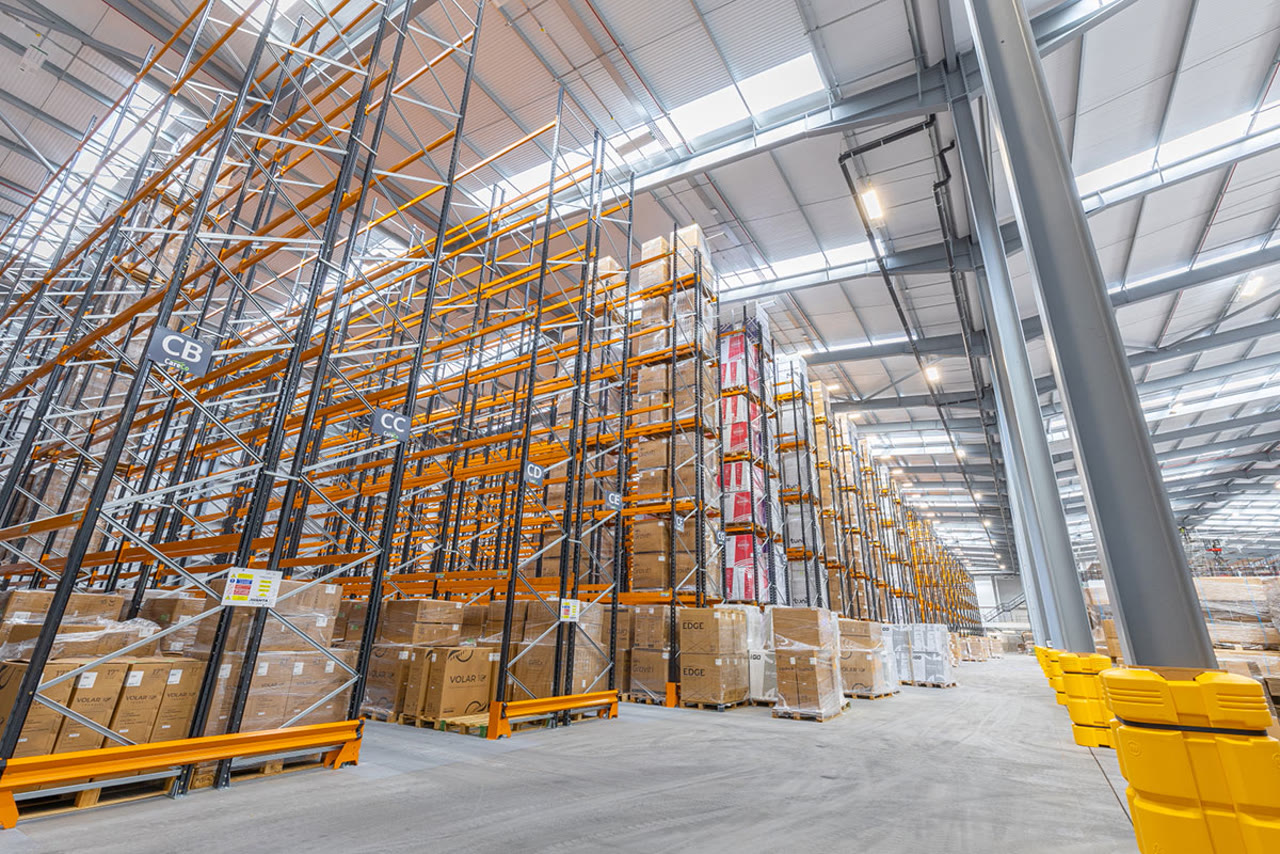
An automated milk run replaces the driver-operated tow tractor and its train of trailers with one or more autonomous mobile robots (AMR) that carry out the same line-supply round, repetitively and without direct human intervention. It's the robotized version of a principle borrowed from the milkman: arrive at a fixed time, pick up the empties, drop off the full ones. This article explains why and how to automate this round with an AMR such as the autonomous pallet truck (2 tonnes).
Automated milk run and line-side tow train: definition
The milk run (« the milkman's round ») is a regular, timed supply round that serves several points of consumption, usually line-side workstations in a factory, from a store or a staging area. The associated vehicle, in France, is commonly called a « petit train logistique » (logistics tow train) or a train of trailers hitched to a tractor, either driver-operated or, on some sites, already automated (source: Groupe Lean, Opéra Partners).
The principle: instead of delivering each workstation in push flow and large volumes, the tow train runs at fixed intervals (every 10, 20 or 30 minutes), drops off full containers and takes back empty ones, in direct connection with kanban and just-in-time. It is a pillar of lean manufacturing applied to a factory's internal logistics.
The automated milk run applies this same principle with an autonomous vehicle: the loop, the stops and the pace stay the same, but human piloting disappears from the task itself. It is a form of incremental automation of intralogistics, with no conveyor or floor-mounted rail.
Why set up an automated milk run
A task that is repetitive by nature
The milk run is, by construction, a round with a fixed route and fixed timing. That is precisely the type of task mobile robotics is best suited to take over: a stable route, known stopping points, a steady pace. Unlike a variable picking mission, the repetitiveness of the milk run reduces navigation complexity and makes the return on investment easier.
Pace, a non-negotiable constraint
In pull flow and just-in-time production, a delay on the round immediately affects line-side workstations, potentially as far as a line stoppage. An AMR programmed to run its loop at a fixed interval, 24/7 if needed, removes the variability linked to breaks, shift changes or the shifting assignments of a multi-skilled forklift operator.
The strain of a repetitive task
Driving a tow train for hours, round and round the same routes, is a repetitive, low-value-added task for a skilled operator. Automating the milk run frees up that human time for inspection, preparation or maintenance tasks, while keeping mechanization as the guiding prevention principle (manual carrying and moving of loads remains, by regulation, the exception versus mechanization — Articles R4541-3 and R4541-5 of the French Labour Code).
A response to the shortage of driving positions
The current shortage in equipment-driving occupations reinforces the case for reassigning available drivers to higher-value tasks (preparation, quality control, maintenance) rather than a repetitive loop.
How an AMR like the robot fills this role
The robot is an autonomous pallet truck (AMR) with a 2,000 kg maximum load, launched on August 18, 2026, designed for pallet handling with no infrastructure work. Its features make it a natural candidate for line-side milk runs.
- Infrastructure-free navigation: the autonomous pallet truck combines 3D LiDAR and depth cameras (multi-sensor fusion, an « AI-native » approach), with no QR codes or floor reflectors. The milk-run loop can therefore be redefined in a few clicks if the workshop layout changes — a key point in industry, where re-layouts are frequent.
- Fast pallet pick-up: forks inserted in around 20 seconds, pick-up at 90° in 2-metre aisles, with automatic correction of an offset of up to 15 cm and 15° of angle. The robot compensates for placement inaccuracies with no manual confirmation.
- 2-tonne capacity: enough for loads of component pallets, full bins or standard containers typical of a line-side flow, including pallets of liquids or beverages in the food industry.
- Runtime suited to timed rounds: around 12 hours unloaded, 6 hours at full load, with a recharge time of about 2 hours, consistent with repeated loops across one shift or several.
- Fleet management: missions are piloted through its fleet supervision platform (dispatch, API, call button), with multi-robot coordination that works even with no external network connection — useful for synchronizing several milk-run loops on the same site.
- Active safety: real-time detection of people and obstacles, dynamic avoidance, intelligent stopping and route recalculation, relevant in a workshop with mixed pedestrian-robot traffic. As no certification (ISO 3691-4, CE) is mentioned on the product page to date, this point should be validated with the distributor before deployment.
On the regulatory side, CACES R489 covers ride-on handling trucks and therefore does not, as such, cover a driverless AMR; the reference for driverless trucks is the EN ISO 3691-4 standard, and the employer remains required to train and inform operators and staff working near the robot. It is recommended to have this point validated with your Carsat or the INRS before commissioning.
Documented industrial cases
The milk-run/tow-train concept is a classic of the French automotive industry, and two cases of robotizing internal factory flows are documented today in the French ecosystem.
- Stellantis Sochaux has deployed AGVs and « butlers » paired with a full-kitting approach to supply assembly lines (source: France Bleu).
- Stellantis Caen operates 43 MiR robots, running around 1,000 missions per day in 24/7 operation, with a goal of fully automating internal flows by 2030 (source: Mobile Industrial Robots).
- Renault Villeroy has deployed 191 AI-piloted Exotec Skypod robots for spare-parts logistics, cutting processing time sixfold and increasing order throughput by 25% (source: CIO Online) — an intralogistics robotization case adjacent to the milk run, illustrating the scale a fleet of mobile robots can reach in a French factory.
These cases involve fleets of light robots or automated storage systems; to date, no documented case of a 2-tonne milk run with the robot has been published, as the product was only launched on August 18, 2026. It is, however, a use case the manufacturer itself lists among the robot's applications: line-side supply in factories, alongside pallet handling in warehouses and transfers in distribution centres.
Before/after: comparison table
| Criterion | Milk run with driver-operated tow train | Automated milk run (AMR such as the robot) |
|---|---|---|
| Round pace | Dependent on driver availability and breaks | Fixed, repeatable, can run 24/7 |
| Maximum load per mission | Variable depending on tractor and trailers | Up to 2,000 kg per mission (the robot) |
| Adapting to a re-layout | New training/instructions for the driver | Loop re-published via the fleet management platform |
| Traceability of runs | Manual or self-reported logging | Missions automatically timestamped (audit support) |
| Human assignment | One driver tied up on the loop | Driver reassigned to higher-value tasks |
| Driving regulatory framework | CACES R489 (ride-on truck) | Outside R489 scope; reference is EN ISO 3691-4 + employer training, to be validated with Carsat/INRS |
| Investment | Purchase/rental of tractor + trailers | Purchase, rental or RaaS for an AMR (autonomous-pallet-truck market ~€30,000-150,000, excluding the robot, whose France price is not public) |
FAQ
What is a milk run in logistics?
The milk run is a regular, timed supply round, generally between a store and line-side workstations, that drops off full containers and takes back empty ones at fixed intervals. It is a pillar of lean manufacturing and just-in-time, tied to kanban.
Can an AMR really replace a logistics tow train?
Yes, for repetitive rounds with a fixed route, where the AMR takes over the route, the stops and the pace. The route can still be redefined with no floor infrastructure. Cases such as Stellantis Caen (43 MiR robots, ~1,000 missions/day) show this is feasible in a factory.
Do you need a CACES certificate to operate an automated milk run?
Not strictly, no: CACES R489 targets ride-on handling trucks. A driverless AMR falls instead under the EN ISO 3691-4 standard and training/authorization issued by the employer. It is recommended to validate this point with your Carsat or the INRS.
What load capacity is needed for a line-side milk run?
It depends on the containers being carried: bins, pallets of components or of liquids. A 2-tonne AMR such as the robot covers most pallet loads in a line-side flow, with forks inserted in around 20 seconds.
Related reading
- AGV vs AMR: the differences, to understand the two families of mobile robots usable for a milk run.
- Logistics robots: the different types, an overview of the families of robots, including load-carrying AMRs.
- Stellantis, Renault: what French factories have learned from mobile robots, the Caen and Villeroy cases in detail.
- Carrying 2-tonne loads: what autonomous solutions are there?, the payload capacity for sizing a milk run.
- Do you need a CACES certificate for a handling robot?, the regulatory framework applicable to AMRs.
- Kitting and line-side supply: organizing just-in-time, the preparation side of this same topic.
Automating your milk run with the autonomous pallet truck
Looking to robotize a line-side supply round with no infrastructure work and no floor-mounted rail? Discover the robot, the 2-tonne autonomous pallet truck distributed in France by Easy to Carry, and request the free site pre-assessment, based on four questions about your flow.
Let's assess your aisles before everyone else does
Distribution opens soon in France. In the meantime, four questions are enough: your regional contact sends back a written verdict on your site, with no price and no date.