
Autonomous pallet truck vs forklift operator: the full cost comparison (TCO)
August 18, 2026 · 8 min read
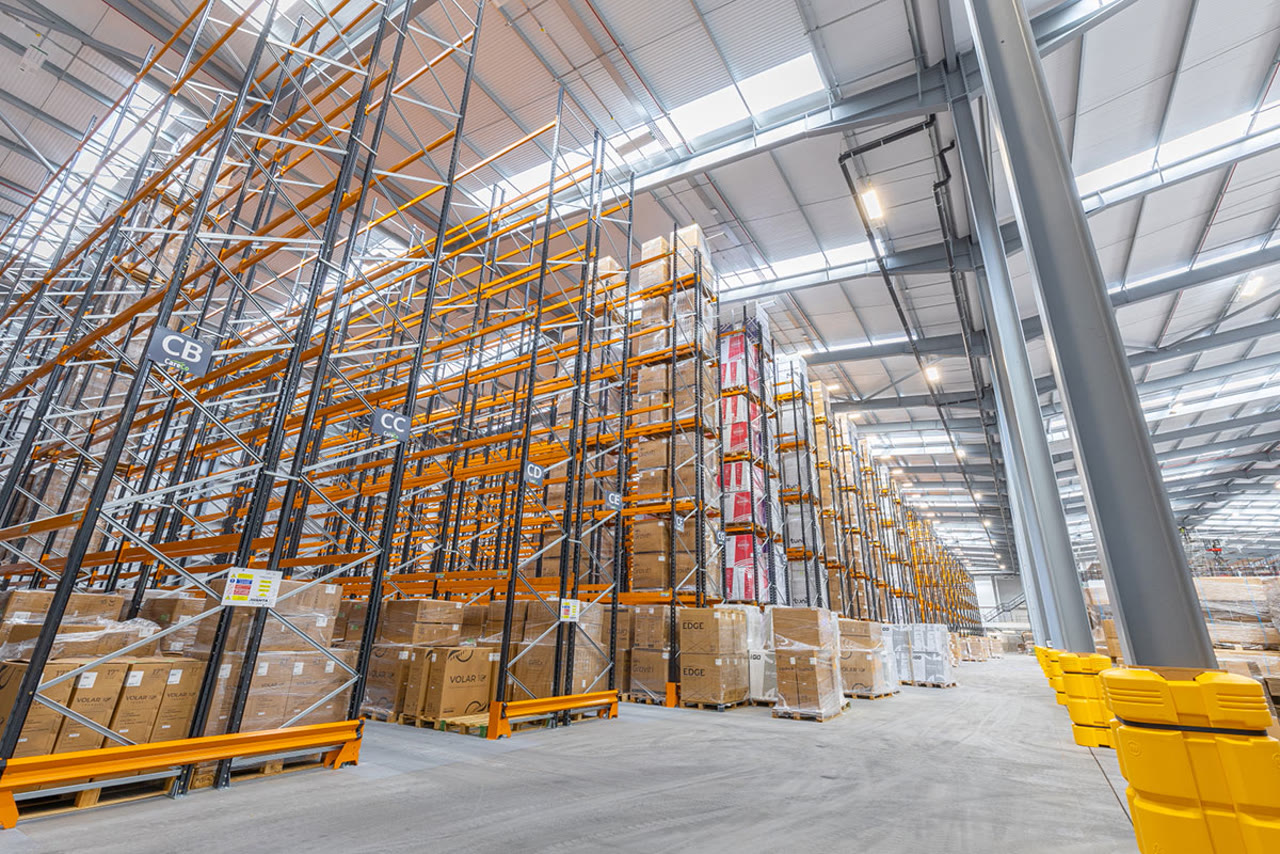
A forklift operator represents a fully-loaded employer cost of €35,000 to €55,000 a year; an autonomous pallet truck costs €30,000 to €150,000 to buy and is depreciated over 3 to 5 years. But the right calculation isn't about pitting human against machine: the robot absorbs repetitive, low-value trips, while the operator keeps the tasks where they're irreplaceable. Here is the full comparison, method and figures included.
Autonomous pallet truck vs forklift operator: what are we really talking about?
An autonomous pallet truck is a mobile robot (AMR) that moves pallets on the ground, with no operator on board or at the tiller. It takes on transfer trips: dock-to-storage shuttles, line-side supply, production clearance.
This comparison isn't a "man vs machine" duel. France has around 15,000 vacant forklift operator positions in 2026, and 40% of logistics companies say a shortage of qualified staff is holding back their growth (source: Focusur, 2026). The robot first comes in to fill positions you can't manage to fill.
Robotisation "assists" more than it replaces (source: France Travail), and automation remains largely a minority practice in French warehouses (source: Amalo). So the real question is economic: for a given flow, what does each option cost over 3 to 5 years?
Methodology: how to calculate an honest TCO
TCO (Total Cost of Ownership) adds up all the costs of a solution over its lifetime: acquisition or salary, operation, training, maintenance, induced costs. Comparing a purchase price to a monthly salary makes no sense.
Three rules make the comparison honest.
- Compare over the same period: 3 to 5 years, the usual depreciation period for autonomous equipment.
- Think in positions, not people: a flow covered in 2 shifts ties up 2 employees; in 3 shifts, it ties up 3.
- Count the hidden costs on both sides: absenteeism, turnover and accident claims on the labour side; integration, maintenance and supervision on the robot side.
One last caveat: we work with sourced ranges; a serious TCO should always be recalculated with your own flow data.
What a forklift operator really costs per year
Salary is only the visible part. A forklift operator earns around €1,800 to €2,600 gross or more per month depending on experience, excluding night or Paris-region premiums (source: Staffmatch). Over the year, that's roughly €26,000 to €41,000 gross, i.e. a fully-loaded employer cost of around €35,000 to €55,000 (sources: Staffmatch, Journal du Net).
| Cost item | Order of magnitude (France) | Source |
|---|---|---|
| Monthly gross salary | ~€1,800 (entry-level) to €2,600 and up (senior); Paris region +10 to +20%; night shift up to +35% | Staffmatch |
| Annual gross salary | ~€26,000 to €41,000 | Staffmatch, Journal du Net |
| Fully-loaded employer cost | €35,000 to €55,000 / year | Staffmatch, Journal du Net |
| CACES training R489 | €700 to €1,100 excl. VAT (initial, 3 to 5 days) + refresher €450 to €750 every 5 years | caces.fr |
| Temp forklift operator (CACES 1/3/5) | €1,800 to €2,400 gross/month, pushed up by the shortage | Focusur |
| Workplace accident (if one occurs) | ~€4,800 direct on average; €19,000 to €29,000 including indirect costs, excluding the resulting rise in the AT/MP contribution rate | Inforisque |
Temp staff make up around 14% of logistics headcount (source: Crit), and any temp worker assigned to an at-risk position requires enhanced safety training: turnover carries a recurring cost, in money and in supervisory time.
What an autonomous pallet truck costs over 3 to 5 years
On the robot side, the French market for autonomous pallet trucks (AGV and AMR) sits between €30,000 and €150,000 excluding integration, depending on capacity, navigation technology and fleet software (source: Travail & Industrie). Since the robot's price isn't published, it's built on a quote based on your site.
Depreciated over 5 years, this investment represents €6,000 to €30,000 per year, on top of which come lighter operating cost items.
| Cost item | Order of magnitude | Comment |
|---|---|---|
| Acquisition | €30,000 to €150,000 excluding integration | Market range for AGV/AMR (source: Travail & Industrie) |
| Annual depreciation | €6,000 to €30,000 / year over 5 years (€10,000 to €50,000 over 3 years) | Simple division of the acquisition cost by the period |
| Integration and commissioning | On request | Infrastructure-free SLAM-navigated AMRs (no rails, no wire-guidance) reduce this item |
| Maintenance | Manufacturer contract, on request | Often included in rental or RaaS plans |
| Energy | Marginal item | Lithium battery, full charge in ~2 h, top-up charging possible during downtime |
| Supervision | Fraction of a position | Launching missions, handling exceptions, often assigned to a trained forklift operator |
| Available grants | Up to 70% of the equipment subject to conditions | Carsat prevention grants / FIPU fund, caps of roughly €1,000 to €75,000, an up-to-date DUERP required |
Two points of honesty. The 40% robotics super-depreciation scheme has ended: don't count on it in your financing plan; the active grants run through the Assurance Maladie and Carsat prevention schemes. And since maintenance and integration are quoted on request, insist your supplier provide a written TCO including these line items.
Avoided costs: MSDs, accidents and vacant positions
The third pillar of TCO, often overlooked, is the costs that autonomous handling helps avoid.
Health, first. Lower-back pain accounts for 20% of workplace accidents, and nearly half of back-related accidents are linked to manual handling; a musculoskeletal occupational disease of the lower back costs an average of €44,000 for around a year off work, and it's the leading cause of unfitness for work before age 45 (INRS). MSDs account for more than 80% of recognised occupational diseases and more than 11 million working days lost per year (INRS).
Accidents, next. Manual handling is involved in around 48 to 53% of workplace accidents resulting in at least 4 days off work (Assurance Maladie, 2023). And each accident costs €19,000 to €29,000 once indirect costs are included (source: Inforisque).
Vacant positions, finally. An unfilled forklift operator position costs you slower flows, overtime and pricier temp staff. With 88,000 unfilled positions in logistics in Q2 2024 (source: Amalo) and 50.1% of hires seen as difficult (France Travail, BMO 2025), this opportunity cost is a lasting one.
Autonomous pallet truck vs forklift operator: two conservative costed scenarios
Let's apply the method to two typical, deliberately conservative situations: only the loaded cost of the labour assigned to a transfer flow, against the equipment's depreciation, with no grants and no avoided costs.
| Scenario A: dock-to-storage shuttle in 2 shifts | Scenario B: continuous flow in 3 shifts | |
|---|---|---|
| Labour assigned to the flow | 2 forklift-operator positions | 3 successive positions |
| Annual fully-loaded cost (€35-55k / position) | €70,000 to €110,000 | €105,000 to €165,000 |
| Autonomous equipment | 1 robot | 1 to 2 robots (charging windows to plan for) |
| Annual depreciation over 5 years | €6,000 to €30,000 | €12,000 to €60,000 |
| Annual gap, before maintenance and integration | €40,000 to €104,000 | €45,000 to €153,000 |
Three caveats for reading this table. These gaps include neither maintenance, nor integration, nor supervision: ask your quote to itemise them; the returns on investment observed on the market remain at 18 to 36 months (sources: Generix, Mobile Industrial Robots). They assume a regular flow that genuinely keeps these positions busy: a marginal flow badly skews the equation. Finally, in 3 shifts, battery life means recharging has to be planned, possibly with a second robot.
Above all, these forklift operators don't simply "disappear." In a market with 15,000 vacant positions, the realistic scenario is twofold: not replacing positions that are already vacant, and redeploying current operators to the tasks that require a human.
The robot's limits: when the forklift operator remains essential
An honest comparison also has to list what the autonomous pallet truck doesn't do. The forklift operator remains essential for.
- High-level storage: a pallet truck, autonomous or not, lifts the pallet a few centimetres. Racking up pallets in height remains the job of mast trucks and operators holding CACES R489 (categories 3 and 5 in particular).
- Loading and unloading trucks: trailers, tail lifts, load securing, safety protocols with the carrier — a highly variable environment that only a few specialised dock robots are starting to address.
- Outdoor areas and damaged floors: yards, outdoor docks and large thresholds remain the territory of driven vehicles.
- Extreme environments: for a cold room, require the manufacturer's stated operating temperature range, since it isn't always published.
- Exceptions and decisions: a damaged pallet, an urgent reorganisation, priority arbitration — the robot flags it, the human decides.
- Small flows: if the trip to be automated doesn't amount to the equivalent of a full position, the 18-to-36-month ROI seen on regular flows won't materialise.
The HR perspective: freeing up, upskilling, retaining
The forklift-operator role is in high demand, not a variable to be trimmed. The AFT describes AMRs as "collaborative solutions" that call for new skills: flow mapping, WMS integration, maintenance, change management (source: AFT).
International data confirms this middle path: 41% of employers reduce some headcount through automation, but around 50% redeploy their staff (source: World Economic Forum, 2025). In practice, an operator freed from repetitive shuttle runs becomes a fleet supervisor, a quality lead or the person overseeing value-added flows.
It's also a retention lever. Fewer monotonous trips means fewer MSDs, fewer early cases of unfitness for work and a more attractive job, at a time when one in two hires is judged difficult (France Travail, BMO 2025). The robot doesn't empty the warehouse of its forklift operators: it helps keep them.
FAQ
How much does a forklift operator cost the company per year?
Between €35,000 and €55,000 per year in fully-loaded employer cost, for an annual gross salary of €26,000 to €41,000 depending on experience and region (sources: Staffmatch, Journal du Net). On top of that comes CACES training and its refresher every 5 years, plus the induced costs of absenteeism, turnover and accident claims.
What is the price of an autonomous pallet truck?
Autonomous pallet trucks (AGV/AMR) range from €30,000 to €150,000 excluding integration, depending on capacity, navigation and fleet software (source: Travail & Industrie). The price of an autonomous pallet truck is not published: it is set on a quote, based on your site, your flows and the service level required.
Does an autonomous pallet truck replace a forklift operator?
No. It takes on repetitive, low-value-added trips — dock-to-storage shuttles, line-side supply — and frees up forklift operators for stacking, truck loading and handling the unexpected. With around 15,000 vacant forklift operator positions in France (source: Focusur, 2026), it mainly fills roles that go unfilled.
Do you need a CACES certificate to use an autonomous pallet truck?
CACES R489 covers ride-on handling trucks; a driverless robot falls outside that scope. The applicable reference is the EN ISO 3691-4 standard, and the employer remains required to train staff who supervise the robot or work nearby. Have your setup validated with your Carsat and the INRS.
What is the ROI of a pallet-truck robot?
The returns on investment observed on AGVs/AMRs fall between 18 and 36 months on regular flows (sources: Generix, Mobile Industrial Robots). Carsat/FIPU prevention grants can fund up to 70% of the equipment subject to conditions, which shortens that timeframe accordingly. An irregular or marginal flow lengthens it considerably.
Related reading
- ROI of a pallet-truck robot: calculation and payback period
- Forklift operator shortage: 5 practical solutions
- Autonomous pallet truck price in 2026
- Do you need a CACES certificate for an electric or autonomous pallet truck?
- autonomous pallet truck: a complete overview of the autonomous pallet truck
- Forklift operator turnover and absenteeism: what they really cost the warehouse, and the costs robotisation avoids in detail.
Move from theoretical calculations to your own real figures. The autonomous pallet truck, distributed in France by Easy to Carry, carries pallets up to 2,000 kg fully autonomously, with no infrastructure work. Discover the robot or request the free site pre-assessment based on your flows.
Let's assess your aisles before everyone else does
Distribution opens soon in France. In the meantime, four questions are enough: your regional contact sends back a written verdict on your site, with no price and no date.