
Warehouse Logistics DUERP: The 10 Risks You Can't Afford to Miss (+ Template)
August 18, 2026 · 8 min read
The warehouse logistics DUERP (Document Unique d'Évaluation des Risques Professionnels — France's mandatory single workplace risk-assessment document) is what every employer must maintain from the very first employee, to identify and rank the occupational risks at their site, from manual handling to working alongside machinery. This article details the 10 specific risks to document, the assessment method, the update frequency, and a summary checklist so nothing gets missed.
What is a warehouse logistics DUERP, and why is it mandatory?
The Document Unique d'Évaluation des Risques Professionnels (DUERP) — France's mandatory single workplace risk-assessment document — is the inventory, maintained by the employer, of every risk employees are exposed to, position by position and work unit by work unit. In a warehouse, it covers manual handling, vehicle traffic, work at height, loading docks and, increasingly, working alongside mobile robots.
The DUERP is mandatory from the very first employee, whatever the size of the company (source: diagnoz.fr, amsn.fr). It is not an optional formality reserved for large sites: a three-person warehouse is required to draft it and keep it up to date, just like a 200-employee logistics platform.
Beyond compliance, the warehouse logistics DUERP is also the gateway to several prevention-funding schemes: Carsat grants for handling equipment that reduces musculoskeletal disorders (MSDs), for example, require an up-to-date DUERP to process the application.
The 10 risks to include in a warehouse logistics DUERP
A warehouse combines risks rarely found together elsewhere: manual load-carrying, vehicle traffic, storage height, docks open to the outside. Here are the 10 risks this warehouse logistics DUERP documents, along with their regulatory references.
1. Manual handling and musculoskeletal disorders (MSDs)
Manual load-carrying remains the number-one warehouse risk. Article R4541-9 sets an absolute ceiling of 105 kg and requires a medical fitness assessment above 55 kg of regular carrying; for women, the maximum is 25 kg (40 kg including wheelbarrow use). Lower-back pain accounts for 20% of workplace accidents, half of them linked to handling, and remains the leading cause of unfitness for work before age 45 (INRS).
2. Same-level falls and falls from height
Falls account for 27 to 32% of workplace accidents resulting in at least 4 days off work in 2023 (Assurance Maladie), just behind manual handling. Cluttered floors, docks, mezzanines and elevated order-picking stations are the risk areas to map first.
3. Vehicle-pedestrian traffic and collisions
No maximum speed is set nationally for indoor forklifts: it's up to the employer to define one in their risk assessment (common reference: 10-12 km/h). The DUERP must document aisle width (INRS ED 6002), floor marking (order of 4 November 1993) and the separation of pedestrian and vehicle traffic.
4. Loads falling from racking
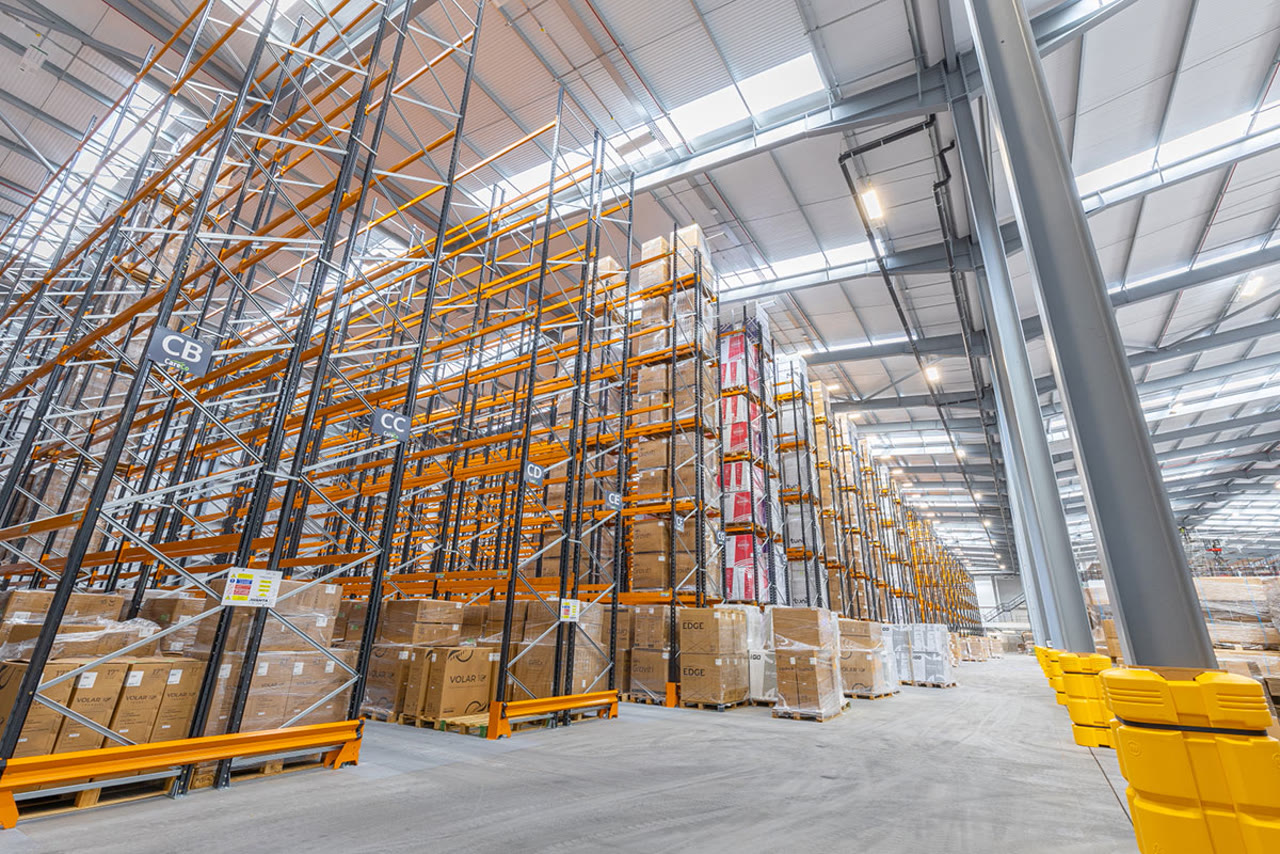
High storage carries the risk of falling loads or instability in racking that is poorly loaded or struck by a vehicle. This risk depends directly on the design and upkeep of the racking, and calls for regular inspection combined with control of forklift traffic nearby.
5. Operators working alongside autonomous vehicles (AMR/AGV)
The arrival of autonomous mobile robots (AMR) introduces a new risk: human-machine cohabitation that falls outside the traditional scope of CACES R489, designed for ride-on trucks. The technical reference is the EN ISO 3691-4 standard; it is recommended to validate training and authorisation arrangements with Carsat or INRS before any deployment.
6. Electrical risk and lithium batteries
The growing electrification of handling fleets (both forklifts and robots) introduces a battery-related risk: EU regulation 2023/1542 now governs the recycling, collection and battery passport of the lithium batteries used in warehouses, a point to build into the DUERP as the fleet becomes electrified.
7. Loading and unloading operations at the docks
Every operation carried out with an outside carrier must be covered by a written safety protocol (Articles R4515-4 to R4515-11), in addition to design recommendations (INRS ED 6059) and dock-approach guidance (ED 6208). This is a high-risk area because it mixes in-house staff, outside drivers and vehicles.
8. Using temporary staff without enhanced training
Forklift driving and other at-risk warehouse positions are among the assignments where enhanced safety training is mandatory for temporary workers (Article L4154-2). Its absence exposes the employer to a presumption of inexcusable fault in the event of an accident.
9. Insufficient lighting
The legal minimums in Article R4223-4 (40 lux in traffic lanes, 60 lux in warehouses, 120 lux in work areas) are well below the recommendations of standard EN 12464-1 (roughly 200 to 500 lux depending on task precision). A rigorous DUERP documents the gap between the legal minimum and genuinely recommended practice.
10. Arduous work: postures, vibration, extreme temperatures
Six factors grant rights under the C2P professional prevention account: night work, rotating shifts, repetitive work, hyperbaric environments, noise and extreme temperatures. Manual handling, arduous postures and vibration were removed from the C2P in 2017, but remain risks to prevent and can be co-funded through the FIPU fund since 2023.
Summary table of the 10 risks in a warehouse logistics DUERP
| # | Risk | Key reference |
|---|---|---|
| 1 | Manual handling / MSDs | R4541-9, INRS back-pain data |
| 2 | Same-level and height falls | Assurance Maladie 2023 statistics |
| 3 | Vehicle/pedestrian traffic | INRS ED 6002, 1993 marking order |
| 4 | Loads falling from racking | Rack design/upkeep |
| 5 | Human-robot coactivity (AMR/AGV) | EN ISO 3691-4, Carsat/INRS |
| 6 | Electrical risk / lithium batteries | EU regulation 2023/1542 |
| 7 | Loading/unloading at docks | R4515-4 to R4515-11, ED 6059/6208 |
| 8 | Temp staff without enhanced training | Article L4154-2 |
| 9 | Insufficient lighting | R4223-4, EN 12464-1 |
| 10 | Arduous work: postures, vibration, temperatures | C2P factors, FIPU fund |
Assessment method: how to build your DUERP
Building a warehouse logistics DUERP follows a three-step logic: identify the work units (receiving, storage, order picking, shipping, docks), list the risks specific to each one, then score them by frequency and severity. INRS offers dedicated tools, including fact sheet ED 6161 for analysing physical workload and the TJ 18 legal memo for handling.
Every company must also appoint at least one employee as health-and-safety officer (Article L4644-1), responsible for steering this process and keeping the document up to date as the site evolves.
The DUERP is not just a list: it must lead to a prioritised prevention action plan, with concrete measures (mechanisation, signage, training, protocols) matched against each identified risk.
Updating the DUERP: frequency and obligations
The warehouse logistics DUERP is not a static document. It must be updated at least once a year in companies with 11 or more employees, and whenever a major change alters working conditions: a new racking layout, a change of handling fleet, the introduction of mobile robots, a new dock.
Since the 2022 Workplace Health law, the DUERP and its successive versions must be kept for 40 years, making it a long-term traceability record that can be consulted in the event of a dispute or occupational illness arising years after the initial exposure.
What does an employer risk without an up-to-date DUERP?
A missing or outdated DUERP first exposes the company to a compliance risk during a labour-inspectorate audit. But the heaviest risk mainly materialises after a workplace accident: a missing or obviously incomplete DUERP makes it easier to demonstrate a breach of the employer's safety obligation, an aggravating factor when inexcusable fault is being established — the same logic applied to untrained temporary workers (Article L4154-2).
Finally, an up-to-date DUERP is a condition for accessing several Carsat grants that fund equipment reducing handling risks: its absence can therefore also close the door to prevention funding.
Warehouse logistics DUERP checklist: the summary template
To build or update your warehouse logistics DUERP, here are the points to check, work unit by work unit.
- Manual-handling positions are identified and R4541-9 thresholds are met (medical fitness, weight limits for men/women).
- Fall-risk areas (docks, mezzanines, floors) are mapped.
- The traffic plan separates pedestrian and vehicle flows, with aisle widths documented.
- The condition of the racking and rack loading are inspected regularly.
- Cohabitation with autonomous vehicles (AMR/AGV), where applicable, is assessed with Carsat or INRS.
- The lithium-battery risk is included if the fleet is electrified.
- A written safety protocol exists for every loading/unloading operation.
- Temporary workers assigned to at-risk positions receive enhanced training.
- Lighting levels are measured and compared against the legal minimums and standard EN 12464-1.
- Arduousness factors (night work, repetitive tasks, extreme temperatures...) are recorded, even outside the C2P.
FAQ
Is the DUERP mandatory for a company with just one employee?
Yes. The warehouse logistics DUERP is mandatory from the very first employee, whatever the size of the company (source: diagnoz.fr). There is no headcount threshold below which the employer is exempt; only the formal annual update frequency is reserved for companies with 11 or more employees.
How often must the DUERP be updated?
In companies with 11 or more employees, the DUERP must be updated at least once a year. In all cases, regardless of size, an update is mandatory whenever a major change alters working conditions: new racking, a new handling fleet, mobile robots, a new dock.
How long must the DUERP be kept?
Since the 2022 Workplace Health law, the DUERP and its successive versions must be kept for 40 years. This long retention period makes it possible to trace an employee's exposure to a given risk, even years later, particularly in the event of an occupational illness or a subsequent dispute.
Who must draft the DUERP in a warehouse?
Drafting it is the employer's responsibility, who can draw on the mandatorily appointed health-and-safety officer (Article L4644-1), on employee representatives and, for technical aspects, on INRS resources (fact sheets ED 6161, TJ 18) or an occupational-risk-prevention consultant.
Must the DUERP include autonomous mobile robots?
Yes: as soon as an AMR or an AGV operates on site, human-robot coactivity must appear in the warehouse logistics DUERP. The technical reference is the EN ISO 3691-4 standard; it is recommended to validate authorisation and training arrangements with Carsat or INRS before deployment.
Related reading
- Workplace accidents: the logistics sector figures, the sector data to factor into DUERP risk scoring.
- Warehouse aisle width: the INRS figures to follow, the regulatory detail behind the traffic risk.
- What is the maximum weight an employee can carry?, the detail of Article R4541-9 cited under risk #1.
- Handling aids: when are they mandatory?, the prevention measures for the MSD risk.
- Do you need a CACES certificate to operate a handling robot?, a deeper look at risk #5, human-robot coactivity.
- Mobile robot and forklift operator cohabitation in a warehouse: the protocol to formalise, to build into the human-robot coactivity risk.
- Mobile robot in a washable food-industry zone: IP69K and compliance, the sector-specific version of the coactivity risk.
- Warehouse floors and handling equipment: flatness, gradients and thresholds, the dock-area safety protocol in detail.
- MSD prevention in logistics: obligations and 2026 Carsat grants, the up-to-date DUERP condition for the grant.
- Outdoor and between-building mobile robots: what's possible, extending the DUERP to outdoor areas.
Documenting the human-robot coactivity risk in your warehouse logistics DUERP starts with choosing equipment designed to operate safely alongside your teams. Discover the robot, the 2,000 kg autonomous pallet truck, or request the free site pre-assessment to work with our team on the prevention measures suited to your site.
Let's assess your aisles before everyone else does
Distribution opens soon in France. In the meantime, four questions are enough: your regional contact sends back a written verdict on your site, with no price and no date.